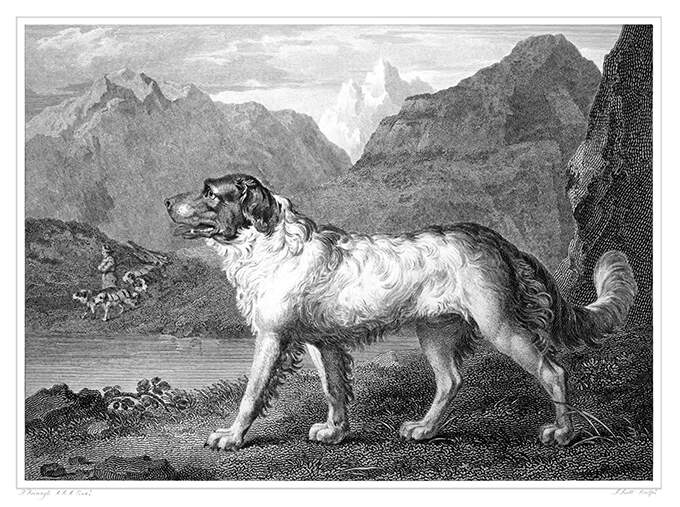
30 August 1803 The early breed of a Newfoundland Dog like Lewis’s dog, Seaman The keel boat was finished at 7 AM, Lewis, with pilot T. Moore, and 11 men -7 soldiers & 3 men on trial basis – load the boat and head down the Allegheny and Ohio River at 11 AM.(1) T. Moore was paid $70.00 as a river pilot to guide Lewis to Louisville.(2) Note : There is a discrepancy between Lewis’ Journal entry for 30 August and his letter to Jefferson of 8 September where he states they left on 31 August at 10 AM. Getting the keel boat loaded with supplies by the temporary crew was extremely important to Lewis but he did not mention an important member of the expedition, Seaman his Newfoundland dog. In a few days Seaman was catching Squirrels as they swam across the Ohio River. Seaman had cost Lewis $20.00, a wise investment. Seaman’s importance to the expedition is shown as a guard dog and when Lewis named a creek for him in Montana.
Lewis understood the challenges he was facing with low water levels in the Ohio River. His letter to Jefferson on 15 July 1803, immediately after arriving in Pittsburgh, noted the dry conditions and “extremely dusty” roads.(5) Subsequent letters to the President before the departure from Pittsburg clearly show Lewis’ concern for the water level in the river. Lewis was wise to employ a pilot for the trip to Louisville. Zadock Cramer was not the first to describe the Ohio River and the land on either side of the “la Bell River” or “Oyo” as it was called by the Iroquois Indians but he was the most prolific publisher. Cramer produced the first Ohio and Mississippi Navigator in 1801 with 12 updated editions that followed through the 1824 version. The Navigator was the bible for navigating the Ohio River gravel bars and falls. We have no firm record of Moore or Lewis having a copy but failure to have a copy would be foolish for a pilot earning $70.00 for the trip with all of Lewis’ exploration supplies. The updated 6 th edition of The Navigator even contained information, from William Clark’s letters and the Patrick Gass Journal about the Lewis and Clark Exploration. It is unfortunate that Lewis did not have the maps and narrative description developed by French General George Henri Victor Collot. In March 1796, Collot traveled overland from Philadelphia to Pittsburgh then followed the Ohio, Mississippi, and a portion of the Missouri Rivers before traveling to New Orleans via the Mississippi. Collot’s cartographic information was very accurate, even if recorded by a French spy. Unfortunately, Collot’s maps and narrative were not published until 1826.(6) The Ohio River has been a transportation artery for emigrants and industry through out recorded history. Almost 100-years after Lewis and Clark used the “interstate highway” of 1803, Reuben Gold Thwaites, with his family of four, started at Brownsville, PA, on the Monongahela River, and traversed the Ohio River in a skiff equipped with a sail. Afloat on the Ohio was first published in 1897.(7) Was Thwaites already thinking about editing the Lewis and Clark Journals ? For a more modern-day view of the Ohio River that Lewis faced with his untried crew, and exploration supplies in a new keel boat, Always a River: The Ohio River and the American Experience is an excellent collection of scholarly essays edited by Robert L. Reid.(8) The Lewis and Clark Journals, and documents are filled with lessons. One of the first teachings was entered in the second sentence of the Ohio River Journal- Treat all Firearms with Caution. Arriving at Bruno’s Island, only three miles after departure from Pittsburg, Lewis showed-off his air gun to a group of gentlemen and allowed Mr. Blaze Cenas to examine the gun. Unfamiliar with the gun, Cenas accidentally shot a woman approximately forty yards away. Fortunately, the wound to the head was superficial and only drew blood.(9) In future demonstrations of the air rifle for the Tribal People, Lewis fires the rifle with caution. Field Notes of Captain William Clark, Osgood, P-22 Source:
Images & Historic Sites
(1) Quaife, Milo,
The Journals of Lewis and Ordway , The State Historical Society, Wisconsin, Madison, page 3; Moulton, Gary, The Journals of the Lewis and Clark Expedition , University of Nebraska Press, Lincoln, page 65.
(2) National Archives & Records Administration, War Department Journal L, 20 Feb. 1805, page 5625 – Lt. Hook at Pittsburgh to T. Moore.
(3) Moulton, Gary,
The Journals of the Lewis and Clark Expedition , University of Nebraska Press, Lincoln, 1986, Vol.-2, page 89
(4) Ibid, 1993, Vol. 5, page 92. (Note: Seamans’ Creek is today’s Monture Creek, MT.
(5) Jackson, Donald,
Letters of the Lewis and Clark Expedition with Related Documents 1783-1854 , University of Illinois Press, Urbana, 1978, Vol. 1, page 110.
(6) Cohen, Paul,
Mapping the West: America’s Westward Movement 1524-1890 , Rizzoli International Publications, Inc., New York, 2002, page, 68-73.
(7) Thwaites, Reuben Gold,
Afloat on the Ohio : An Historical Pilgrimage of a Thousand Miles in a Skiff, from Redstone to Cairo, Southern Illinois University Press, Carbondale, 1999, page 1-2.
(8) Reid, Robert L., editor,
Always a River: The Ohio River and The American Experience , University of Indiana Press, Bloomington & Indianapolis, 1991.
(9) Quaife, Milo,
The Journals of Lewis and Ordway , The State Historical Society, Wisconsin, Madison, page 3; Moulton, Gary, The Journals of the Lewis and Clark Expedition, University of Nebraska Press, Lincoln, page 65.