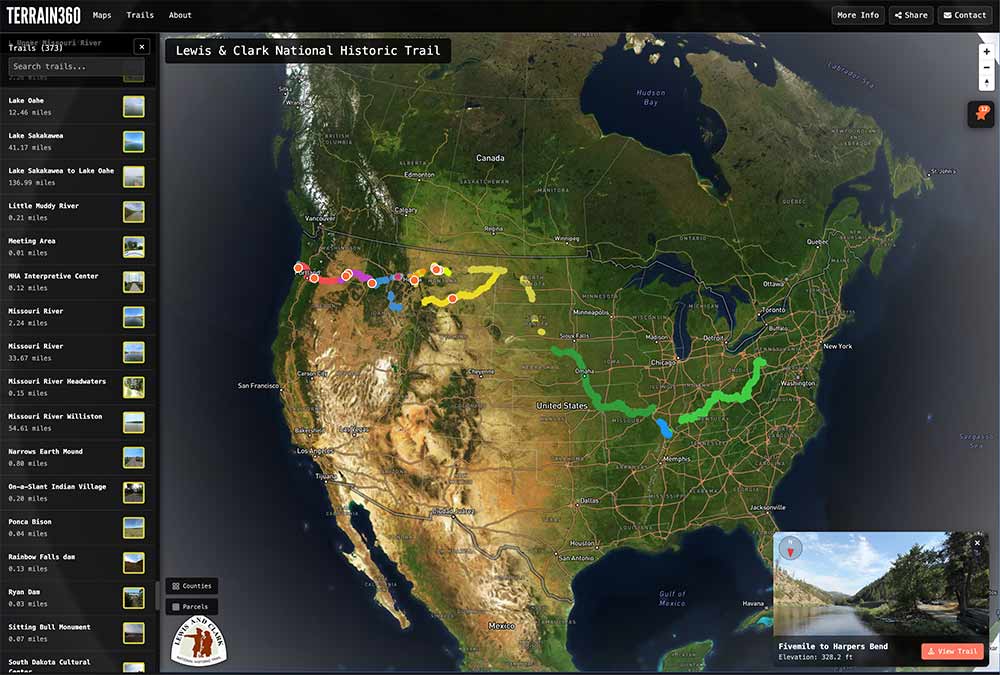
Lewis & Clark National Historic Trail
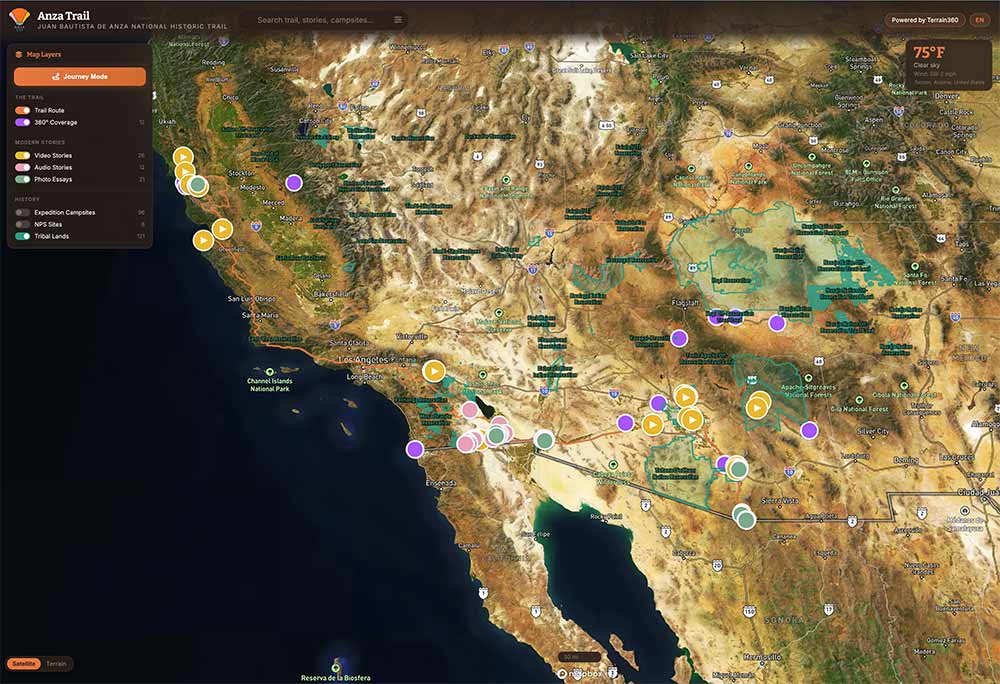
The existing NPS-partnered L&C NHT map. The Katy Trail capture extends this corridor onto the parallel land route Lewis and Clark traveled.

Complete · Rocheport to North Jefferson · July 2026
36 Miles Captured on America's Longest Rail-Trail
Terrain360 has already captured the entire Missouri River, Sioux City to the Confluence, as part of the Lewis & Clark NHT. In July 2026 we added the parallel land corridor: 36 miles from Rocheport to North Jefferson, including the 1893 tunnel and the river bluffs, published as 1,167 scenes. Funded by the Lewis and Clark Trust, free to the public, and ready to seed the full 240-mile corridor.
The Project
The Lewis & Clark National Historic Trail has been a multi-year focus for Terrain360 in partnership with the National Park Service. We have already captured the entire Missouri River from Sioux City to the Confluence — the same waterway the Corps of Discovery rowed up in 1804 and back down in 1806. Browse the live L&C NHT map.
The Katy Trail State Park runs parallel to the Missouri for the great majority of its 240-mile length. Pairing the river corridor (complete) with the land corridor (36 miles captured, the remaining 204 to follow) creates something neither can do alone: a single seamless exploration tool that lets stewards, visitors, and partners move between water and trail in one experience.
Phase one is done. In July 2026 we rode Rocheport to North Jefferson with a mast-mounted 360° camera and published 1,167 scenes across 36.4 miles — the 1893 tunnel, the Moniteau and Perche Creek trestles, the limestone bluffs, Cooper’s Landing, and the Hartsburg bottoms. It was funded by the Lewis and Clark Trust, at no cost to DNR or NPS. Ride it in 360°.
Those miles now anchor a public rider’s guide to the whole corridor at bikethekaty.com: live surface conditions graded from rain history at fifteen points along the trail, a ride planner that checks the wind against the direction you will actually be riding, all 26 trailheads with their services, and the 360° capture at the centre of it. Free, with no account and no advertising. Independent of, and grateful to, Missouri State Parks.
An independent study of five LECL sites found $14.5M in annual visitor expenditures and 195 jobs supported. Lewis & Clark State Park alone supported 106 jobs and $12M in economic output.
The Katy pilot scales that proven model along a 240-mile recreational corridor.
The Corridor
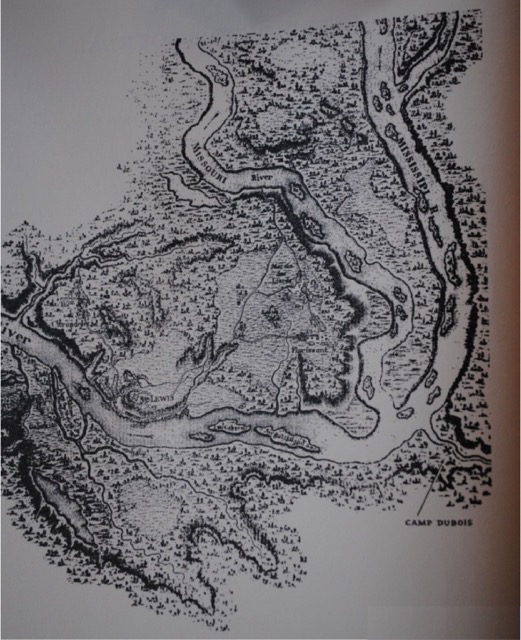
In May 1804 the Corps of Discovery left St. Charles and rowed up the Missouri. In late May and early June they passed through what would become the Katy Trail’s central corridor, the country around Hermann, Jefferson City, Boonville and Arrow Rock, long before any of those towns existed. Along this stretch Lewis and Clark named landmarks and mapped tributaries. Their first council with the Otoe and Missouria came later that summer, in August 1804, at Council Bluff, far up the river in present-day Nebraska. They returned the same way in September 1806.
Eighty years later the Missouri-Kansas-Texas Railroad, the Katy, laid track along the river’s north bank. By the late 20th century the line was abandoned and converted, beginning in 1986, into one of the longest rail-to-trail conversions in the country. Today the Katy Trail State Park draws hundreds of thousands of visitors a year. What it lacks is the same kind of mile-by-mile virtual access that exists for the Lewis and Clark National Historic Trail elsewhere. This project closes that gap.
Lewis and Clark depart St. Charles, traveling up the Missouri along what is now the Katy corridor.
The expedition retraces the river back to St. Louis.
The Missouri-Kansas-Texas Railroad runs line beneath the river bluffs.
Missouri State Parks begins converting the abandoned MKT bed into the Katy Trail.
Terrain360 rides Rocheport to North Jefferson and publishes 1,167 scenes, pairing with the already-complete Missouri River map.
Rocheport to North Jefferson is the stretch we captured — the most recognizable mile on the Katy. Here's what's in it:
$75,000 maps the entire 240-mile corridor end-to-end. That includes the 360° capture, the custom interactive map, a town profile for every trail-town along the corridor, the standalone Katy Trail site, and the backend that lets each town keep its own content current.
36 of those miles are already captured and donated as community match, and the public site they feed is live now at bikethekaty.com. Capture follows construction: we do not promise trail that is not built yet.
If you represent a foundation, agency, or trail-town stakeholder who could underwrite the rest of the corridor — or part of it — let’s start the conversation. Work begins across the remaining corridor as soon as funding lands.
Or email jim@lewisandclarktrust.org directly to start a corridor-funding conversation.
Public projects in the same format we'll deliver for the Katy. Pairs seamlessly with the existing Lewis & Clark NHT map. Click any to explore.
The existing NPS-partnered L&C NHT map. The Katy Trail capture extends this corridor onto the parallel land route Lewis and Clark traveled.
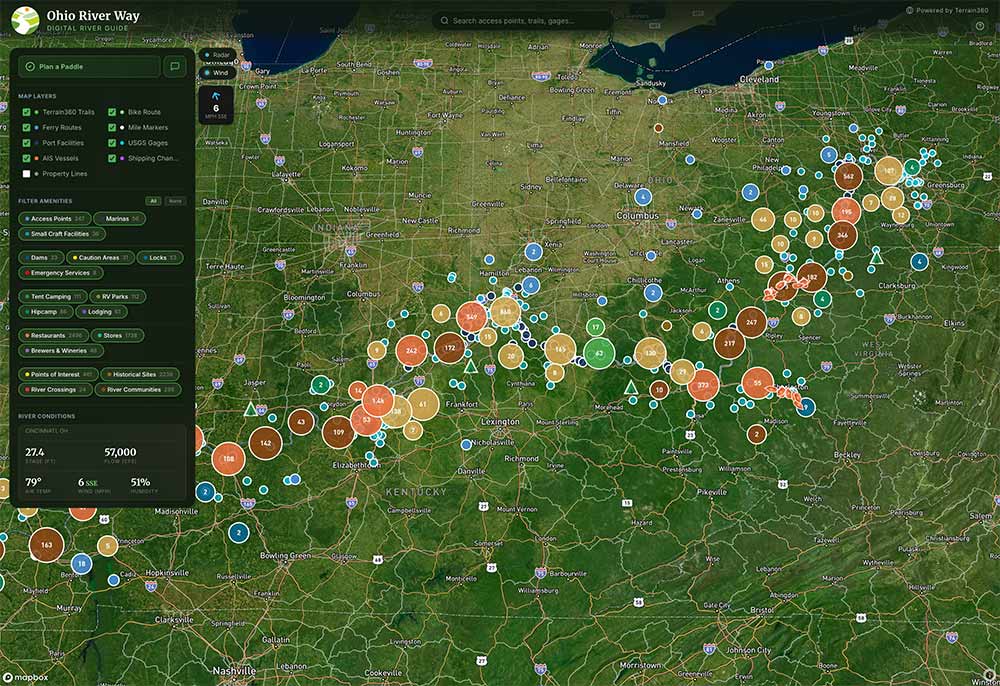
Lower Ohio River exploration tool — full GPS-tagged 360° imagery, conditions, and access points along an L&C corridor.
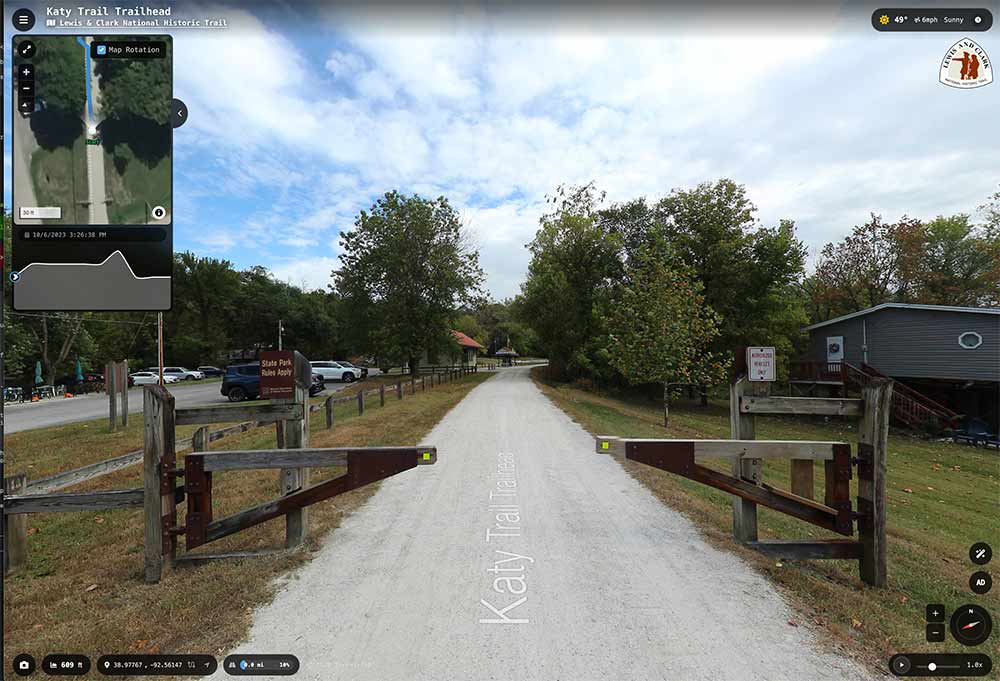
A live frame from Terrain360's Katy Trail capture — a Lewis & Clark NHT trailhead in 360°. Click to explore the viewer, live now across the captured 36 miles.
Multi-state historic trail in 360° — precedent for NHT-scale partnership work with the National Park Service.
A Natural Extension of the Project
The Katy Trail’s natural counterpart is the Rock Island Trail State Park — Missouri’s 93rd state park, designated in 2023 on a corridor donated to Missouri State Parks by Ameren in 2021.
47.5 miles of Rock Island are open today, running from Pleasant Hill to Windsor, where the corridor meets the Katy. An additional ~144 miles from Windsor to Beaufort is being developed by Missouri State Parks, with active 2026 work in Owensville and Versailles.
When complete, Rock Island and the Katy together form a continuous ~450-mile loop — the longest connected rail-trail loop in the United States. We expect to capture the open 47.5 miles in 360° and add new sections as Missouri State Parks completes them. Same equipment, same methodology, same free-public-access posture as the captured Katy miles. The Katy work is under way, so this is a natural next step rather than a new undertaking.
Are you with DNR, NPS, Magnificent Missouri, a friends-of-the-trail group, a chamber, or a trail business? Drop your details and we'll be in touch about segment selection, introductions, and how the captured miles can complement your work.
July 2026 was our capture window — chosen for the full leaf-on canopy that defines the Katy in summer, longer daylight hours, and stable trail conditions after spring rain. The 36-mile Rocheport to North Jefferson segment was funded by the Lewis and Clark Trust, at no cost to DNR, NPS or Magnificent Missouri.
Capture is performed on a single continuous push: a calibrated 360° rig with synchronized GPS, recording every meter of trail at roughly walking pace. Most segments take 2–3 days in the field. Post-processing — image stitching, GPS alignment, blurring of any incidental faces or plates, and tile generation — runs another 2–4 weeks. Public imagery is live on terrain360.com now, alongside the existing Missouri River and L&C NHT maps.
The choice came from the people who steward the Trail. Three lenses shaped it, in this order: (1) what the trail’s stewards prioritized — DNR, Missouri State Parks, Magnificent Missouri, friends groups; (2) heritage value tied to the Lewis & Clark return-route corridor; and (3) visitor demand and trip-planning utility for first-time riders, hikers, and accessibility users.
Rocheport leads on all three. It carries the only tunnel on the Katy and the Missouri River bluffs where Lewis and Clark recorded the pictographs on June 7, 1804 — the trail’s signature mile, and a natural pairing with the river map we’ve already completed.
This is a first segment, not the last. Future blocks remain on the table for a phased full-corridor deployment — McKittrick to Hermann’s wine corridor, the Ted & Pat Jones Welcome Center at Treloar, Defiance / Augusta wine country, and the St. Charles terminus.
Status, October 2026: the Partnership for the National Trails System has confirmed funding through the Lewis and Clark Trust, and Magnificent Missouri is working on the rest. If it comes together in time, the rest of the Katy is captured the week of October 25, 2026; otherwise in late April or mid May 2027.
Phase one was built to seed the conversation about a full-corridor deployment. We expect the path forward to be collaborative and phased — Missouri DNR / State Parks line items, federal grants tied to the Lewis & Clark NHT, philanthropic match through the Lewis & Clark Trust, regional tourism funding, and corporate sponsorship are all live possibilities. We’ve structured the work so that every additional segment is independently fundable — partners don’t have to commit to the whole 240 to move forward.
Capture cadence at full deployment is roughly 30–50 miles per week of field time, weather permitting, plus post-processing. A complete 240-mile Katy corridor would publish in stages over one season once funded.
Free, permanent public access at terrain360.com, alongside the existing Missouri River and Lewis & Clark National Historic Trail maps. No paywall, no app — anything a visitor needs runs in the browser.
For partners we provide:
Terrain360’s posture on this corridor is the same as on the L&C NHT: captured once, free to the public, forever.
Ryan Abrahamsen, Terrain360 founder and the person doing the field capture work, ryan@terrain360.com or 804.677.1456. The fastest path is the partnership form on this page; it routes directly to Ryan and to the Lewis & Clark Trust.
Good fits for a conversation: DNR / Missouri State Parks staff, NPS L&C NHT, Magnificent Missouri, Katy Trail friends groups and chambers of commerce, trail-side businesses, accessibility advocates, and anyone working on the Rock Island corridor. We’re also open to introductions through the Trust: Jim Mallory, Vice Chairman, can flag partner conversations into the right channel.
The Katy parallels the Missouri River for most of its 240 miles — the same corridor Lewis and Clark traveled in 1804 and 1806. Terrain360 has already captured the Missouri end-to-end (Sioux City to the Confluence) as part of our NPS partnership on the Lewis & Clark NHT. Pairing river and trail in one experience unlocks use cases neither side does alone:
No other National Historic Trail has anything like this. The Katy capture is the first step toward making the L&C corridor — water and land, end-to-end — the most thoroughly documented historic trail in the country.