
Stop 28 of 37
To Richmond, VA
William Douglas Meriwether, Executor of the Meriwether Lewis Estate
9th Breakfast 17 mi at Louisa Court House I Staid all night at Mr. Dukes a drunken man bad fair.
10th Sunday Breakfast at Brown Ordinary I Stayed all night with Rich Thompson, met several old school mates who appeared very glad to see me and have old talk.
Monday 11 Dec. 1809, Stayed all night with Cozen Sam Red, saw Mr. Fitahugh and others, much inquiry wife son & family.
Col. Boswell Tavern, VA Green Springs Landmark District
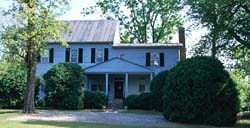
Courtesy: Scenic American, Deborsh Myerson
https://home.nps.gov/grsp/learn/historyculture/boswell-tavern.htm
The morning of 9 December, William and Scot crossed the Albemarle and Lousia County line and passed the Boswell Tavern. The Boswell Tavern, built in the 18th century by Col. John Boswell, is an extant private residence at the intersection of VA 22 and U S 33. While Willian and Scot did not indicate they stopped, the tavern is noted for being a camp for Marquis de Lafayette during the Revolution War. (1) Clark was passing through the historic region of Green Springs, settled during the last half of the 1700s. The soil was rich and favorable for growing tobacco, cotton, and corn. (2)(3) Today the Green Springs Loop is a driving route developed by the Virginia Department of Wildlife Resources. In addition to the wildlife viewing opportunities, the James Madson’s Montpelier and the Historic Town of Louisa anchor each end of the driving loop. (4)
They had breakfast at Louisa Courthouse, paying $1.12 & 1/2. The ordinary in Louisa was near to the Court House, established by Major Thomas Johnson in 1782. While Clark did not comment on the quality of the meal, the ordinary had a reputation for poor food, service, and cleanliness. (5)(6)
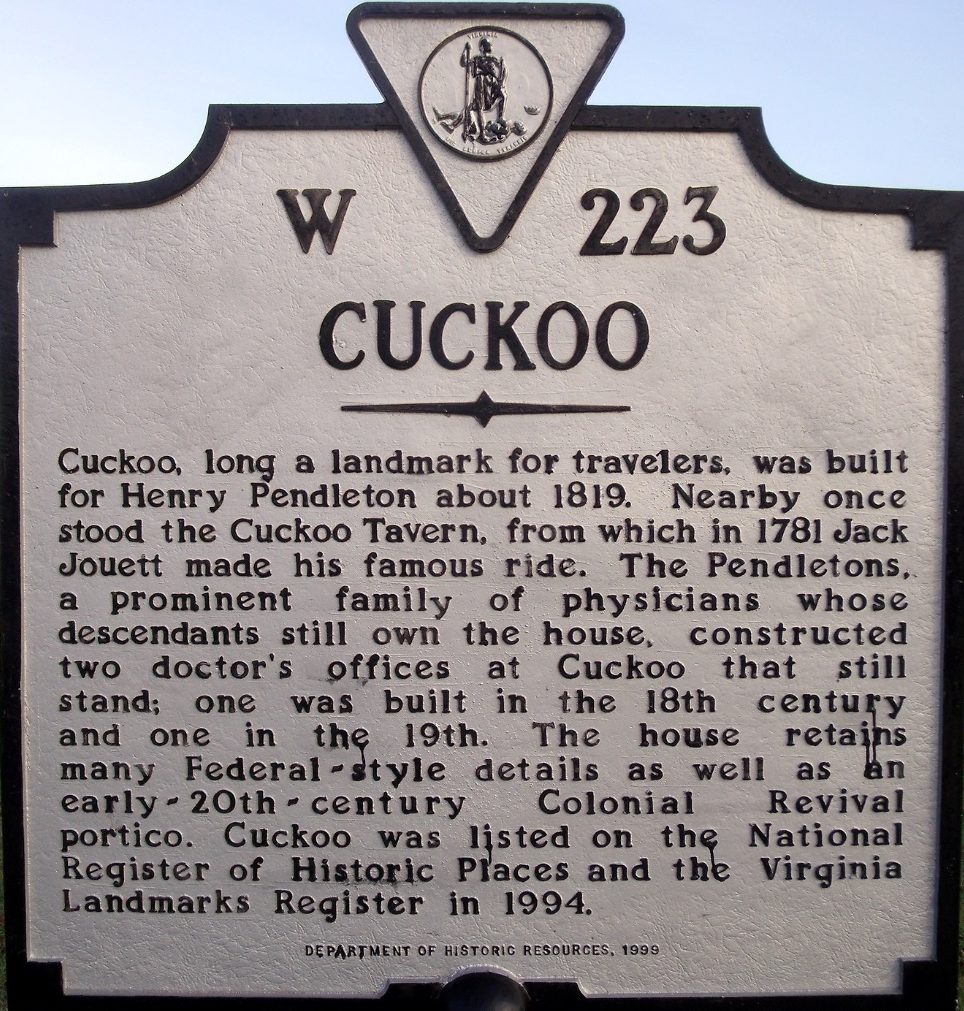
Courtesy: Lewis and Clark Trust
When William and Scot arrived at the intersection of US 33 (Jefferson Highway a.k.a. Mountain Road) and US 522, they were at the Cockoo Tavern owned by John Jouett. Sr. While Clark makes no note of stopping, this is the June 1781, site where 27-year-old John “Jack” Jouett, Jr. started his famous 40-mile ride to Monticello. Jouett followed a shorter cross-country trail to warn Thomas Jefferson and the Virginia Assembly that British Lieutenant Colonel Banastre Tarlton, ‘Bloody Ban’, was approaching. (7)(8) After the Revolutionary War, John “Jack” Jouett moved to Mercer County, Kentucky and married Sallie Robards. Their son, Matthew Harris Jouett, studied law but had a more famous career as a portrait painter. (See # 9 for more on Matthew Harris Jouett)
The evening of 9 December William and Scott stayed at Mr. Dukes, cost was $2.25, commenting, bad fair and had to put-up with a drunk man (37.86718N 77.78750W). The 1863 Hotchkiss Map of Louisa County shows a T. Duke at the Locust Creek Post Office. Today this is the intersection of US 33 (Jefferson Highway, Mountain Road, Richmond Road) and VA 655 (Windyknight Road), approximately 2.8 miles east of the Louisa and Hanover County line. (9)
Sunday morning, 10 December, William, and Scott proceeded along present-day US 33 to Beaver Dam Road, VA 715, stopping for breakfast at Brown’s Ordinary, cost $1.25. Brown’s Ordinary was in the vicinity of the present-day intersection of VA 684 and VA 738. Family and local oral tradition reports that the present-day private residence is built on or near the foundation of Brown’s Ordinary, confirmed by Robert Selig, Revolutionary War Roads and Transportation Survey in the Commonwealth of Virginia 1781-1782. (10)
Historic Coin Collection of William Dabney Terrell, IV (deceased)
Mr. Terrell collected the coins at the Brown’s Tavern site before construction of his home
on the tavern foundation. Are any of the coins part of the $1.25 paid for breakfast?
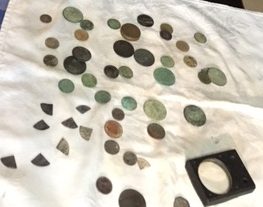
Courtesy: William Dabney Terrell, IV
At digital page 25 in William Clarks 1809 Journal there is an undated entry written upside down from other entries that gives us a glimpse of the interpersonal relation of William Clark to his wife, Julia. Clearly William is missing his wife and son. William wrote:
Art thou a husband? To treat thy wife with tenderness and respect reprove her faults with gentleness, be faithful to her love; give up thy heart to her confidence, and alleviate her cares. Read this often my Dear Love.
Filigree
The only duty of a wife is to be obedient to the will her husband, in all respects.
The Sycamore Tavern in Montpelier is an outstanding example of the ordinaries and stage coach stops during the Colonial Period, located approximately 100 yards east of intersection of US 33 and Beaver Dam Road, VA 715. The tavern was the 4th stage coach stop on the Charlottesville-Richmond Road a.k.a. Mountain Road or Jefferson Highway. Sycamore Tavern was built before 1804 and today serves as the Florence L. Page Library (37.82282N-77.68698W) This historic building is an example of Tidewater - Piedmont Architecture, National Register Number 42-0085. (11)
Florence L. Page Library
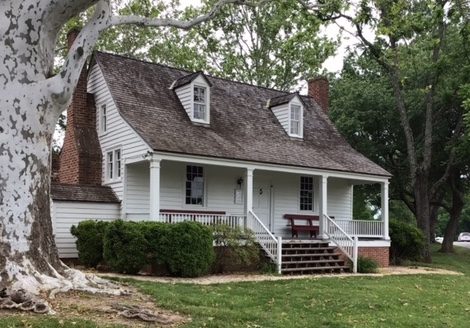
Courtesy: Lewis and Clark Trust
Clark was nearing Caroline County where he was born 1 August 1770 and lived until the age 14. (12) He will spend the night with friends and family associates on the night of 10 and 11 December. On the 10th he stayed with Rich(ard) Tompkins. The Tompkins family had purchased part of the Clark plantation after the Clark family moved to Kentucky. (13) The night of 11 December, William and Scott stayed with Clark’s first cousin Samuel Redd. (14) Clark paid Mr. Redd’s servant Boy $1.50 but he did not explain the service provided.
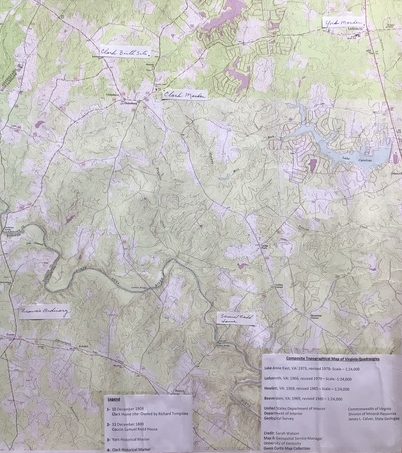
Composite Topographical Maps of VA Quadrangles
Lake Ann East 1973, revised 1978
Ladysmith 1966, revised1979
Hewlett 1969, revised 1985
Beaverdam 1969, revised 1985
Note: Brown’s Ordinary, Clark Birth Site (1809 owned by Richard Tompkins), Samuel Redd House (Ceder Vale), and York Historical Marker are located on the four quadrangles listed above. Caroline, Hanover, and Spotsylvania Counties join in the Clark Family area. Composite Map Courtesy: Sarah Watson, Map & Geospatial Services Manager, University of Kentucky.
Courtesy: Lewis and Clark Trust
An extremely well researched and detailed article by the late Dr. Robert E. Gatten, Ph. D. describes the home site of William Clark in We Proceeded On, May 1993, with a follow-up in May 1999. (14) The area is in the southwestern corner of Caroline Co. VA near the Spotsylvania and Hanover County line on VA 603. (15)(16)
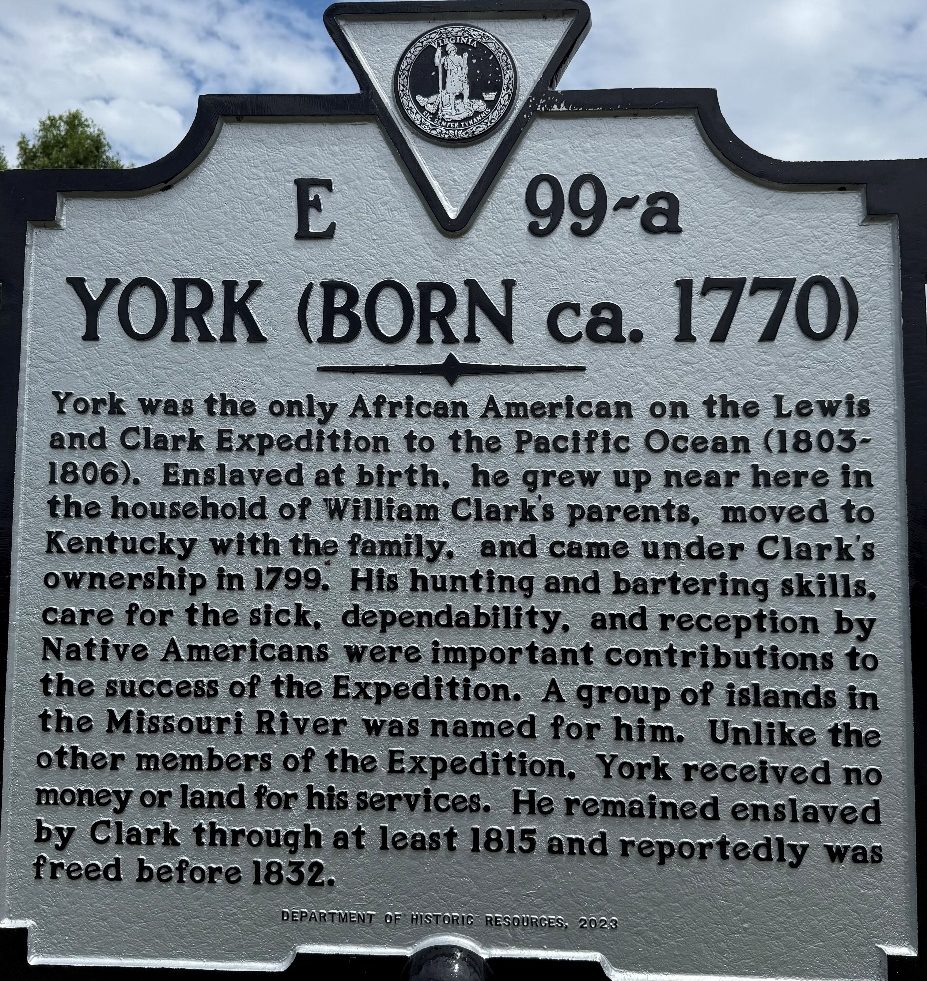
York Birth County, VA
Courtesy: Devry Becker Jones
The 1809 journal clearly records Scot as William Clark’s enslaved servant and traveling partner at this point of the journey. However, this is also the birth area of York, Clark’s enslaved servant that had traveled to the Pacific Ocean and back with the Lewis and Clark Expedition. York is the first recorded African American crossing the North American Continent, coast to coast. (17)
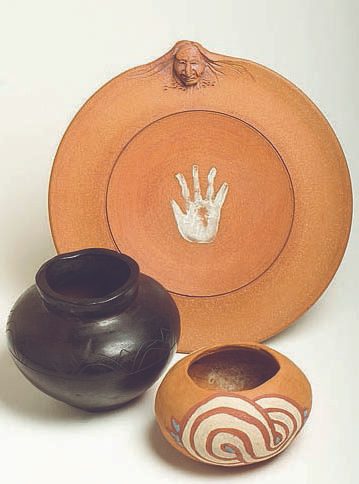
Pamunkey Pottery
Courtesy: Collection of Kevin Brown, Virginia Humanities
Virginia is the home of Indigenous People dating 8,000-6500 BC. The American Indians found on first contact with the Europeans spoke Algonquian, Iroquoian, or Siouan language, though each group could to a degree understand each other. There were several Tribal Groups that live well and in relative peace with each other. (18) William had grown to the age of 14 along the rivers and fields where the Indigenous People had lives for centuries. Did William recognize the relationship between the American Indians he was serving as Superintendent of Indian Affairs in the west and the American Indians that lived in Virginia? Did he meet any of the remaining Tribes that resided in VA? While we will never know, or at least William did not comment on the First People in Virginia, their societies were the foundation for Virginia pre-contact history and their ancestors still survive today in Virginia. (19)
Source:
(1) https://www.dhr.virginia.gov/historic-registers/054-0007/
(2) Architectural History Identification and Assessment of Louisa County, VA, Thomas Jefferson Planning District, VA Dept. of Historic Resources, 1993 Rev. 1995, page 46.
(4) https://dwr.virginia.gov/vbwt/piedmont-trail/pgs/
(5) https://www.louisatown.org/community/town-history/
(6) Cooke, Pattie, Louisa County Virginia: A Brief History, Historic Press, Charleston, SC, 2008, Chapter 4, page 1.
(7) https://explorekyhistory.ky.gov/items/show/469?tour=32&index=4
(8) Haley, Gail, Jack Jouett’s Ride, Viking Press Books for Young Readers, 1973.
(10) https://drive.google.com/drive/folders/1TFIWei0L7qOjzjVbchA00iXgGVVYxjvN , Chapter 8-page 150.
(11) https://www.dhr.virginia.gov/VLR_to_transfer/PDFNoms/042-0085_Sycamore_Tavern_1974_Final_Nomination.pdf
(12) Tubbs, Stephenie Ambrose and Jenkinson, Clay Straus, The Lewis and Clark Companion: An Encyclopedic Guide to the Voyage of Discovery, Henry Holt and Company, New York, 2003, page 62.
(13) Holmberg, James J., Dear Brother: Letters of William Clark to Jonathan Clark, Yale University Press, New Haven, 2002, page 240, note 6.
(14) Ibid, page 240, note 5.
(15) Gatten, Robert E. Jr., Clark Land in Virginia and the Birthplace of William Clark. We Proceeded On, Lewis and Clark Trail Heritage Foundation, May 1999, page 6-11.
(16) Virginia Atlas & Gazetteer, DeLorme Mapping Co, Freeport, Maine, 1989, Page 70.
(17) https://www.hmdb.org/m.asp?m=47378
(18) https://encyclopediavirginia.org/entries/indians-in-virginia/