
Stop 15 of 16
Trouble with the Spanish, 12 December 1803
St. Louis, MO
The Spanish Government would not permit the expedition to spend the winter West of the Mississippi River. "Monday the 12th of December opposite the mouth of the Missouri River I came to the mouth of a little river called Wood River about 2 o'clock," William Clark. Shortly after arriving the wind started to blow with hail and snow at the location of Camp River Dubois, the first winter camp of Lewis and Clark. (1)
Historically, enlisted men in the Army do not like garrison duty and so it was with this camp. The building of cabins was the first-priority. While the expedition exploration journals had not been started, from Osgood's Field Notes of Captain William Clark and Jackson’s Letters we learn that the camp was a busy place. The young recruits started learning military discipline when they broke protocol, that included killing live stock or visiting the local source of liquor in the Great American Bottom where the camp was located. (2)
John Hay, the Post Master at Cahokia, and his wife and others visited the camp and provided information about the region and Missouri River the expedition would confront in the spring. Being friends with the Post Master helped communications with the East and President Jefferson or his Cabinet. (3)
Lewis spent the greater part of the winter in St. Louis gathering information and material for the exploration. However, Clark traveled to St. Louis on ceremonial occasions especially for the transferring of the Louisiana Territory to the United States. Clark's faithful recording of the weather and evaluation of the men during the winter training clearly explains why garrison duty is not appreciated by the recruits.
William Clark Map of Camp Dubois
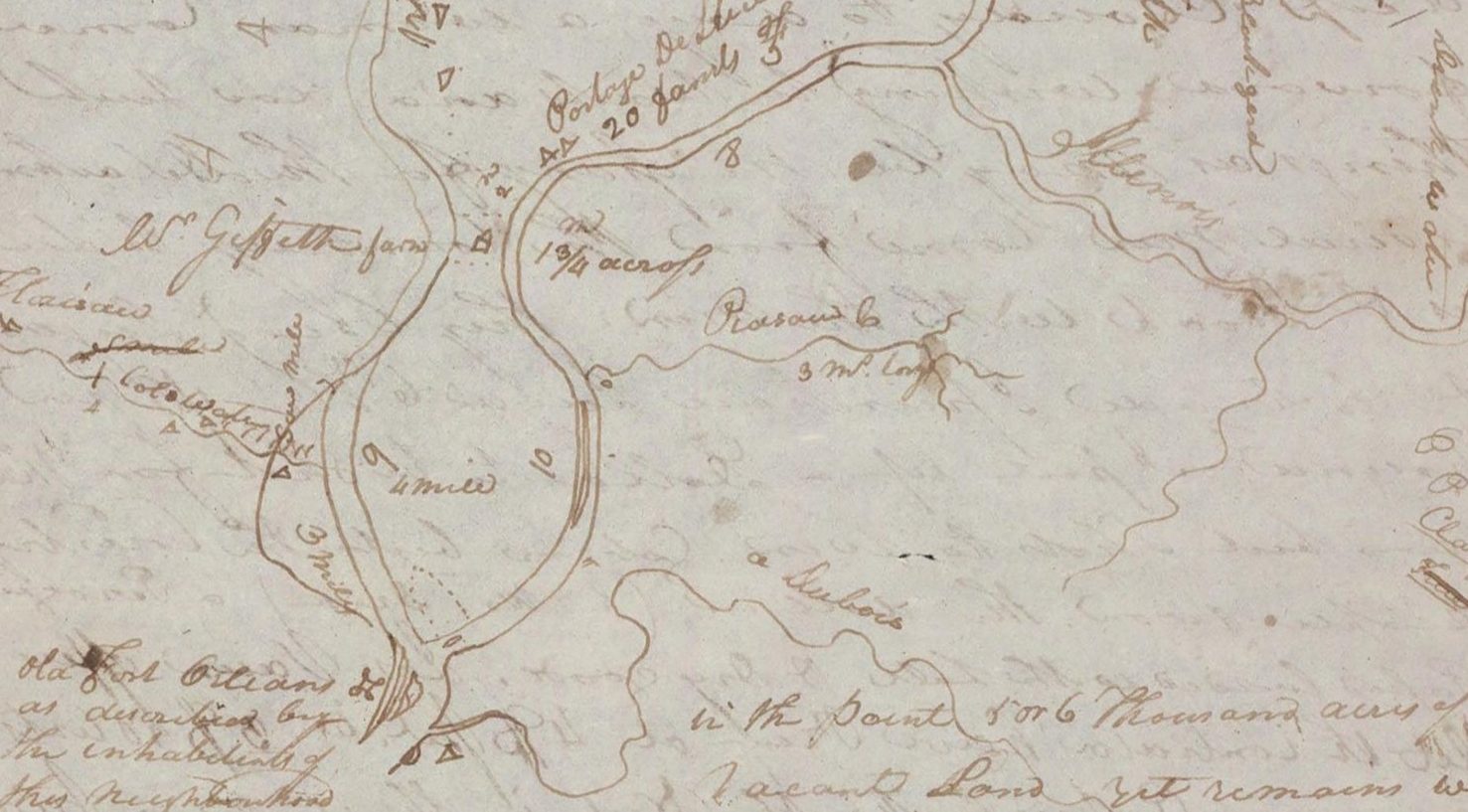
Triangle, immediately above, South of the DuBois River is the site of Camp Dubois.
Courtesy: Beinecke Rare Books and Manuscripts Library, Yale University
An additional Map Number 6, The Lewis and Clark Expedition, Vol. 1 (Atlas) by Gary Moulton, shows the location of Camp Dubois on the southside of the River Dubois and next to the Mississippi Riveras a black rectangle with a note: “The winter encampment in the year 1803-4 of the party sent out by the Government of the United States for the purpose of exploring the Missouri River”.
Lewis and Clark Historic Site Interpretive Center
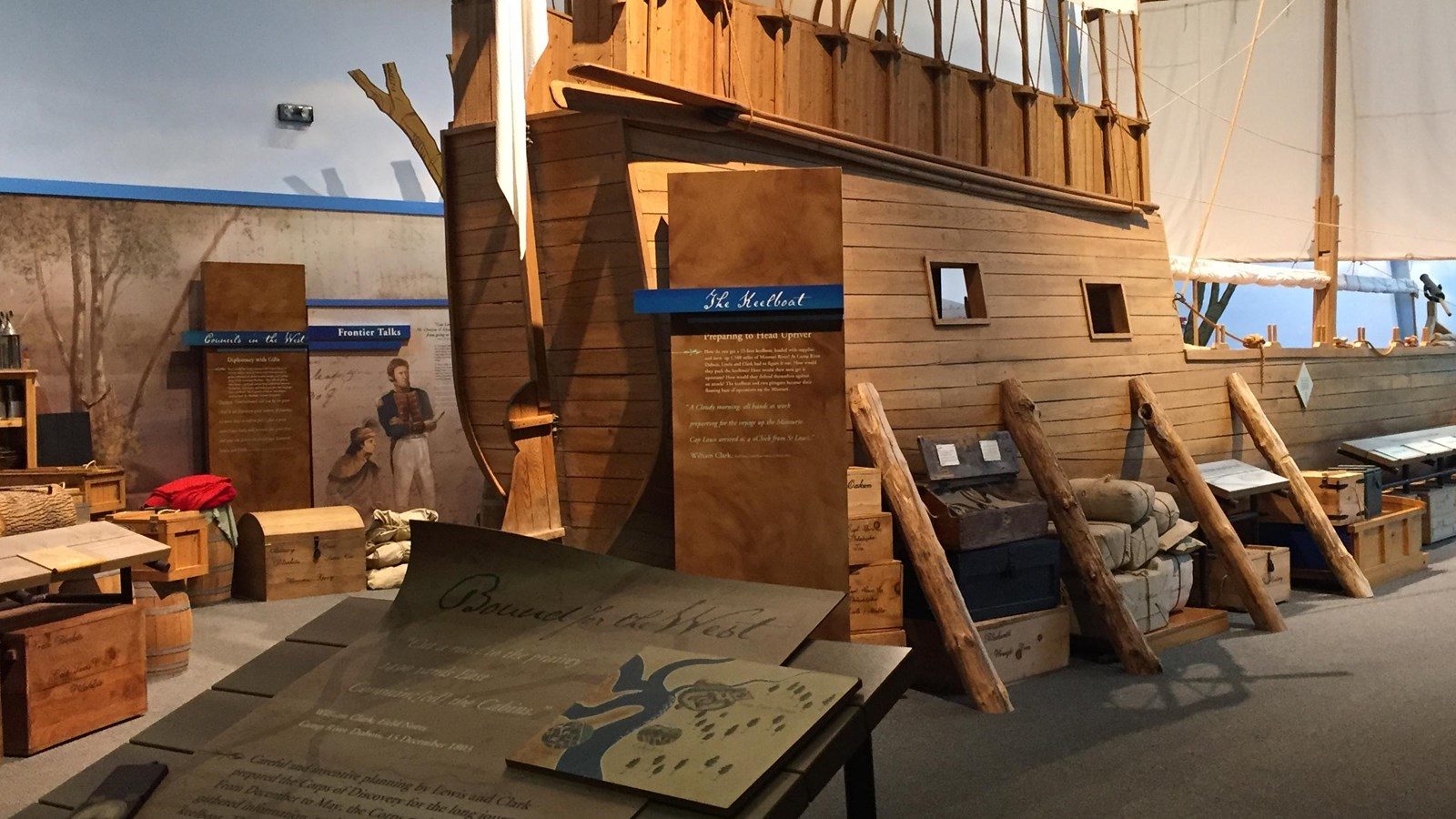
Courtesy: Illinois Department of Natural Resources
1 Lewis and Clark Trail, Hartford, IL 62048
Source:
(1) Osgood, Ernest, Field Notes of Captain William Clark, Yale University Press 1964, p. 3-38.
(2) Quaife, Milo, The Journal of Lewis and Ordway, The State Historical Society of Wisconsin, 1916, P. 48.
(3) Jones, Landon, William Clark and The Shaping of the West, Hill and Wang, New York, 2004, P. 122 - 123.
Editorial Note: The Lewis and Clark Story has many stories within the story. Deviating from date sequence, let us pause and look at one of the internal stories connecting Ft. Mandan, St. Louis, New Orleans, Baltimore, and Washington D. C. in 1805. While the exploration of the Missouri River and its principal tributaries was underway, the story is also very alive and active in the East.
On 7 April 1805 the keel boat, under the command of Corporal Warfington, departed Ft. Mandan, the 1804-1805 winter fort in North Dakota. The boat arrived back in St. Louis late May or very early June 1805, containing the collection of material, observations, and messages collected between St. Louis and Ft. Mandan in 1804-1805. (1) The list of items sent to President Jefferson is well detailed. (2) Fortunately, we can follow the collection to the White House through the research of Scott S. Sheads, NPS Ranger-Historian (Retired). Mr. Shead’s excellent report clearly points to the fact that Baltimore is one of the eastern points on the Lewis and Clark Story.
Lewis and Clark Trust 15 X 15 Flag Flies at Ft. McHenry
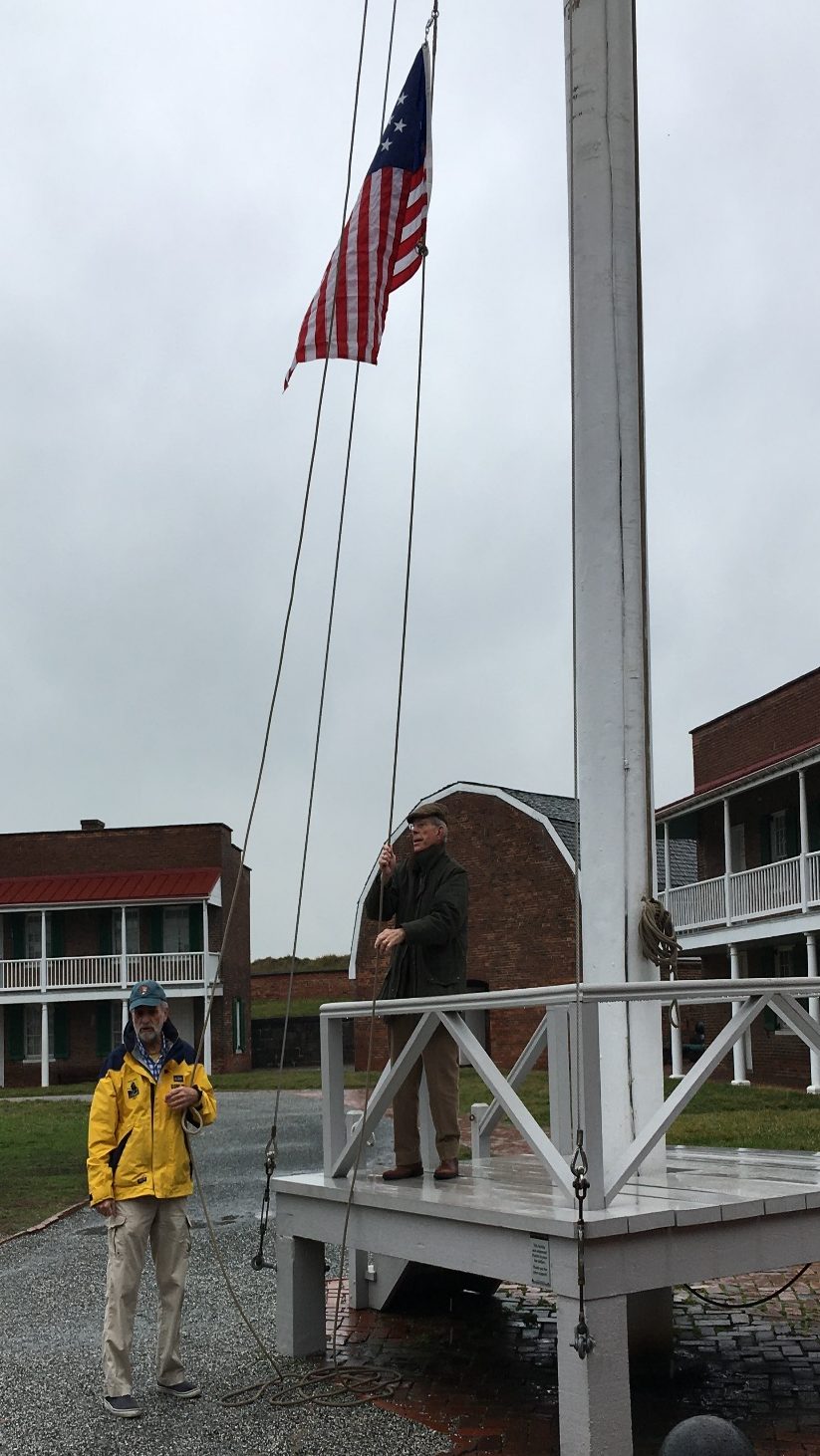
Courtesy: Lewis and Clark Trust
Scott Sheads in Yellow jacket.
Historical document
Curiosities from the Corps of Discovery: by Scott Sheads
Baltimore, August 1805
Meriweather Lewis (1774-1809) & William Clark (1770-1838)
(National Park Service)
” “We learn that a part of the collection of the curiosities collected by captain Lewis on the Missouri, has reached Baltimore.” 1
A year before the formal United States acquisition of the Louisiana Territory from France for $15 million, President Jefferson sent a confidential letter to Congress on January 18, 1803 to fund $2,500 for a scientific expedition up the Missouri River to open a passage to the Pacific through the uncharted north-western frontier.2 To lead the expedition known as the “Corps of Discovery” he appointed his personal secretary Meriweather Lewis for what became and remains the most celebrated natural scientific exploration in American history. While historians and the media have focused on the historic journey from St. Louis to the Pacific, little is known of the Baltimore connection in regards to the valuable shipment that was sent eastward a year after their keelboat named “Discovery” and crew pushed northward on the Missouri.
On April 3, 1805, Captains Merriweather Lewis and William Clark prepared to leave their camp at Fort Mandan (present day Washburn, ND) at the confluence of the Knife and Missouri Rivers for the Upper Missouri to continue their passage to the Pacific coast, since leaving St. Louis on May 14, 1804. 3
The celebrated thirty-one member expedition that later historians called the “Corps of Discovery” spent their days packing their shipment of “curiosities” collected so far to be forwarded to President Jefferson in Washington. The shipment consisted of 4 boxes, 2 large trunks and 5 cages containing a variety of scientific observations, maps, Mandan bow & quiver, botanical specimens, animal skins, and a live prairie dog – in all an impressive inventory of the natural landscape specimens and Native American tribal cultures they were passing through.
While historians have documented the “Corps of Discovery” expedition from St. Louis, up the Missouri and Columbia Rivers to the Oregon pacific coast - little has been written on the final phase – the arrival of the shipment of “curiosities” in August 1805 to Baltimore. This is the untold Baltimore connection.
Baltimorean’s first detailed notice of an expedition to be led by Captain Lewis, the personal secretary of President Jefferson appeared in the Federal Gazette on Sept 20, 1803 followed by the Frederick-Town Hornet that winter informing their readers that a corps of soldiers and hunter-guides were “to proceed to the source of the Missouri, and thence to endeavor by following the course of the great river, to reach the pacific ocean.
This, no doubt, is an expedition of great difficulty and hazard, at the same time, if successful, as we wish it may, [be] of great national importance.” 4 Lewis and Clark were already in St. Louis by May 1804 preparing to shove off up the Missouri.
On April 7, 1805 Captain Lewis sent four men and two interpreters under Corporal Richard Warfington down the Missouri from Fort Mandan in the Dakota’s to St. Louis on the Mississippi.5 Here Captain Amos Stoddard (1762-1813) 2nd U.S. Regiment of Artillerist and Engineers, Captain Lewis’ agent, was responsible for forwarding the shipment to New Orleans then to Washington, via the Gulf Coast to the Chesapeake. 6
The Orleans Gazette informed its readers of the shipment as it passed through the Port of New-Orleans:
“The curiosities sent by Captains Lewis and Clark, to the president of the United States, were received by Governor Claiborne, some days ago – they were put on board the Comet, Captain McNeil, who sailed yesterday for Baltimore. The animal and birds, were in good health.” 7
The Baltimore built Comet, described as “a strong, fast-sailing vessel, and in all respects well found; burthen 197 tons…a constant Trader of freight…” with extensive accommodations for passengers. In addition to her cargo of “curiosities” was 120 Hogsheads of “fine New Orleans sugar” destined for merchant William Taylor. 8
The final passage was entrusted to a Captain John McNeil who had arrived at New Orleans on July 22nd then left on July 23rd for Baltimore 1,750 nautical miles away in the Chesapeake. 9 After a fifteen-day passage they arrived in the Patapsco River on August 10th off Fort McHenry. The long four month navigable journey from Fort Mandan down the Missouri, the Mississippi to New Orleans and finally Baltimore on August 12 was some 4,500 miles with Captain McNeil informing Jefferson by mail of his arrival.10
Across from the Fort on the opposite shore lay the Lazaretto Quarantine Station (est.1801) for vessels arriving from out of the country before entering Baltimore to prevent the introduction of contagious diseases and arriving shipments. A Dr. William Stewart (1741-1821) earlier that Spring been appointed Baltimore’s second Public Health Officer whose duty was “to give his attendance at Fort McHenry every day from eight o’clock in the morning until six o’clock in the evening…” during the quarantine season to check arriving vessels.11
Fort McHenry, November 9, 1803
1803 map showing the Tavern (A) outside the walls of Fort McHenry and outer post gate.12 (National Archives, Record Group 77, Drawer 51, Sheet 1; College Park, Md.)
Dr. Stewart’s office was at Philip Schwartzauer’s Tavern (c.1797-1836) outside the military boundary gate of the fort.13 Walking down to the government dock a small boat would take him across the channel to the Lazaretto station. Upon checking the crew and shipment the Comet was allowed to proceed to the Fell’s Point waterfront wharf of Points of Interest (left to right): Chase’s Wharf, Fell’s Point; Fort McHenry and Lazaretto Quarantine Station. (author)
Thorndick Chase at Thames and Philpot Sts., on August 12th. 14 Here Robert Purviance (1734-1806), Port Collector of Baltimore engaged a local wagon drayer, Nathaniel Peck to take the shipment to the White House for a payment of $12.00 arriving on Aug.14, 1805 and placed under the care of the President’s house manager-steward, a Mr. Etienne Lemaire.15 Lewis and Clark reached St. Louis at noon on September 23, 1806, thus ending the “Corps of Discovery” epic adventure of exploration along the Upper Missouri and Columbia Rivers.
A&CDA, August 15, 1805
By May of 1814 the Baltimore bookstore of John & Thomas Vance at 178 Market Street offered readers their first literary glimpse of the expedition of the “Corps of Discovery” illustrated with maps.16 The twenty-eight-month expedition had explored the country west of the Mississippi, opening America to westward migration, and with it by the close of the 19th century the demise of the Native American lands and culture.
When Jefferson returned to Washington in October, he enumerated the shipment destined to be divided to three sites; artist Rembrandt Peale’s Natural History Museum and the American Philosophical Society (Est. 1743) both in Philadelphia, and of course his Virginia home at Monticello.17
Unfortunately, in March 1806 Jefferson was informed that a large part of the shipment in transit on the Chesapeake destined for Monticello via Richmond “that could be damaged by water was…”18 With Jefferson’s death in 1826 his “Indian Hall” collection though bequeath to the University of Virginia had by the 20th century been lost, mislaid or redistributed as interest declined. Today, only the Elk antlers have survived at Monticello, admits reproductions acquired during the 200th anniversary of the expedition.
Today, the major repository of the surviving shipment resides at the Harvard University, Peabody Museum in Massachusetts. 19
Today, the site of Thorndick Chase’s c.1803 wharf is a National Historic Landmark at Fell’s Point the oldest waterfront warehouse in Baltimore, the site of the Living Classrooms Foundation, Frederick Douglas – Isaac Meyers Maritime Park.
End
Invoice of articles forwarded from Fort Mandan to the President of the United States through Captain Amos Stoddard at St. Louis and Mr. H.B. Trist the Collector of the Port of New Orleans.
Source: National Archives, http://lewisandclarktrail.com/section2/ndcities/newtown/returnbarge.htm
Endnotes
1 Universal Gazette (D.C.), August 22, 1805.
2 The act was entitled “An Act for extending the external commerce of the United States” (approved Feb 28, 1803). The cost for the expedition far exceeded the $2500 proposed by Jefferson. Captain Lewis’s monthly army pay alone was $40, thus for 3 years equaled $1,440. Present day scholars have estimated the cost of $38 -50,000 in 1815 currency.
3 Meriweather Lewis (1774-1809) and William Clark (1770-1838)
4 The Hornet (Frederick, Md., December 13, 1803; Republican Star (Easton, Md), March 29, 1803.
5 Present day Washburn, North Dakota.
6 Stoddard was the acting territorial civil and military governor of Louisiana appointed by Jefferson in 1804.
7 Orleans Gazette and Commercial Adv., (New Orleans, La.), July 24, 1805; William Claiborne to Collector of the Port of Baltimore, July 23, 1805. Letters of the Lewis and Clark Expedition, with Related Documents, 1783-1854, by Donald D. Jackson, (University of Illinois Press, 1978), 253-254; Federal Gazette (Baltimore), August 15, 1805; American & Commercial Daily Adv. (Baltimore), August 12, 1805; Orleans Gazette, July 24, 1805.
8 Baltimore Gazette, November 19, 1803; August 16, 1805.
9 “Merchant’s Coffee-House Books,” Federal Gazette (Baltimore), August 10, 1805; “Ship News, Port of New Orleans, Arrived,” Orleans Gazette and Commercial Adv., July 27, 1805.
10 James McNeill to Thomas Jefferson, August 12, 1805. Coolidge Collection
11 “An Ordnance for the Appointment of a Health office at the Port of Baltimore…’
March 5, 1805. Baltimore Health Department has its origins in 1793 when the state authorized a commissioner of health to take preventive actions against disease. Dr. Stewart later served as surgeon at Fort McHenry during the War of 1812.
12 Nelson, Lee H. An Architectural Study of Fort McHenry, Historic American Buildings Survey, National Park Service (Philadelphia, Pa. 1961), 18-24.
13 "An Act to continue in force “An Act declaring the consent of Congress to an act of the state of Maryland, passed December 28, 1793, for the appointment of a health officer, Approved March 1, 1805. [for the port of Baltimore-town]." “An Ordinance for the appointment of a Health office at the Port of Baltimore.” American & Commercial Daily Advertiser, March 17, 1805.
14 Present day site of the Frederick Douglas-Isaac Myers Maritime Park @ 1417 Thames St.; Thorndick Chase (1755-1838). “Fell’s Point,” National Register of Historic Places Inventory, Maryland Historic Trust, No. 18BC51 (1969); also see Archeological Inventory, Phase II and Phase III, No. B-982.
15 Robert Purviance, Port Collector of Baltimore to James Madison, Secretary of State, August 12, 1805. Thomas Jefferson Papers, Library of Congress; Massachusetts Spy, August 28, 1805; Universal Gazette (D.C.), August 22, 1805; Orleans Gazette and Commercial Adv., July 24, 1805; Federal Gazette (Baltimore), August 10, 1805.
16 History of the Expedition under the Command of Captains Lewis and Clarke, To the Sources of the Missouri, Thence Across the Rocky Mountains, and Down The River Columbia To The Pacific Ocean; Performed During the Years 1804, 1805, 1806.
(Detail) of the title page of the 2-volume leather bound edition published in Philadelphia.
17 Jefferson served as the society’s president from 1797-1815.
18 Jefferson to Lewis, June 4, 1807.& Lewis to Jefferson, June 27, 1807. Jackson, 418.
19 For further information on the surviving collections see the Peabody’s “From Nation to Nation: Examining the Lewis and Clark Indian Collection.”
www.peabody.harvard.edu/node/2470; and Gary E. Moulton’s “The Missing Journals of Meriwether Lewis,” Montana: The Magazine of Western History, Volume 35, Summer 1985, pages 28-39.
In addition to the port of entry for the first collection sent to President Jefferson, the Fells Point warehouse, located east of the Inter Harbor of Baltimore, is an excellent example of a port warehouse built during the 1800s. The Living Classrooms Maritime Park, adjoining the warehouse is an excellent site for learning by doing.
Living Classroom Foundation Marina
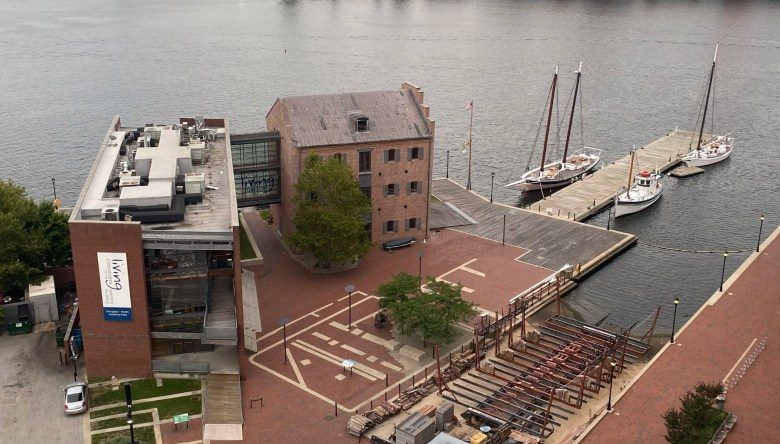
Frederick Douglas- Issac Myer Maritime Park, 802 South Caroline Street, Baltimore, MD 21231
“Learning by Doing” Living Classroom Foundation
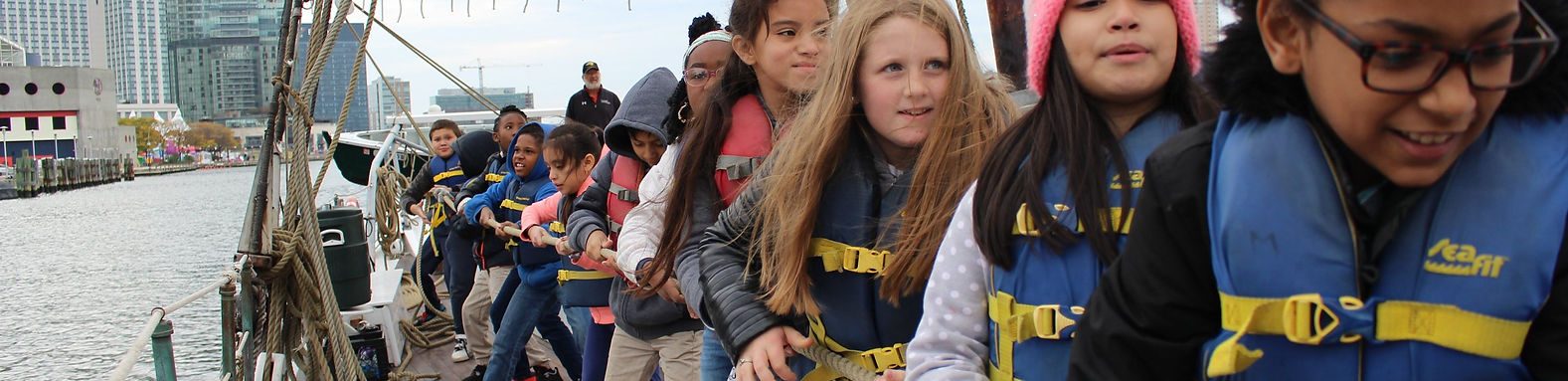
Courtesy: Living Classroom Foundation
Walters Museum, Baltimore, MD
Baltimore’s Walters Museum is home for two hundred excellent water color paintings of the American West by Alfred Jacob Miller. (3) The Miller paintings, commissioned by Capt. William Drummond Stewart, are equal to or exceed any of the early western American paintings of Tribal People, animals, and landscape scenes representing the people and scenery that the expedition was viewing as they traveled toward the Rockey Mountains along the Missouri River.
Indian Mother and Children by Alfred Jacob Miller
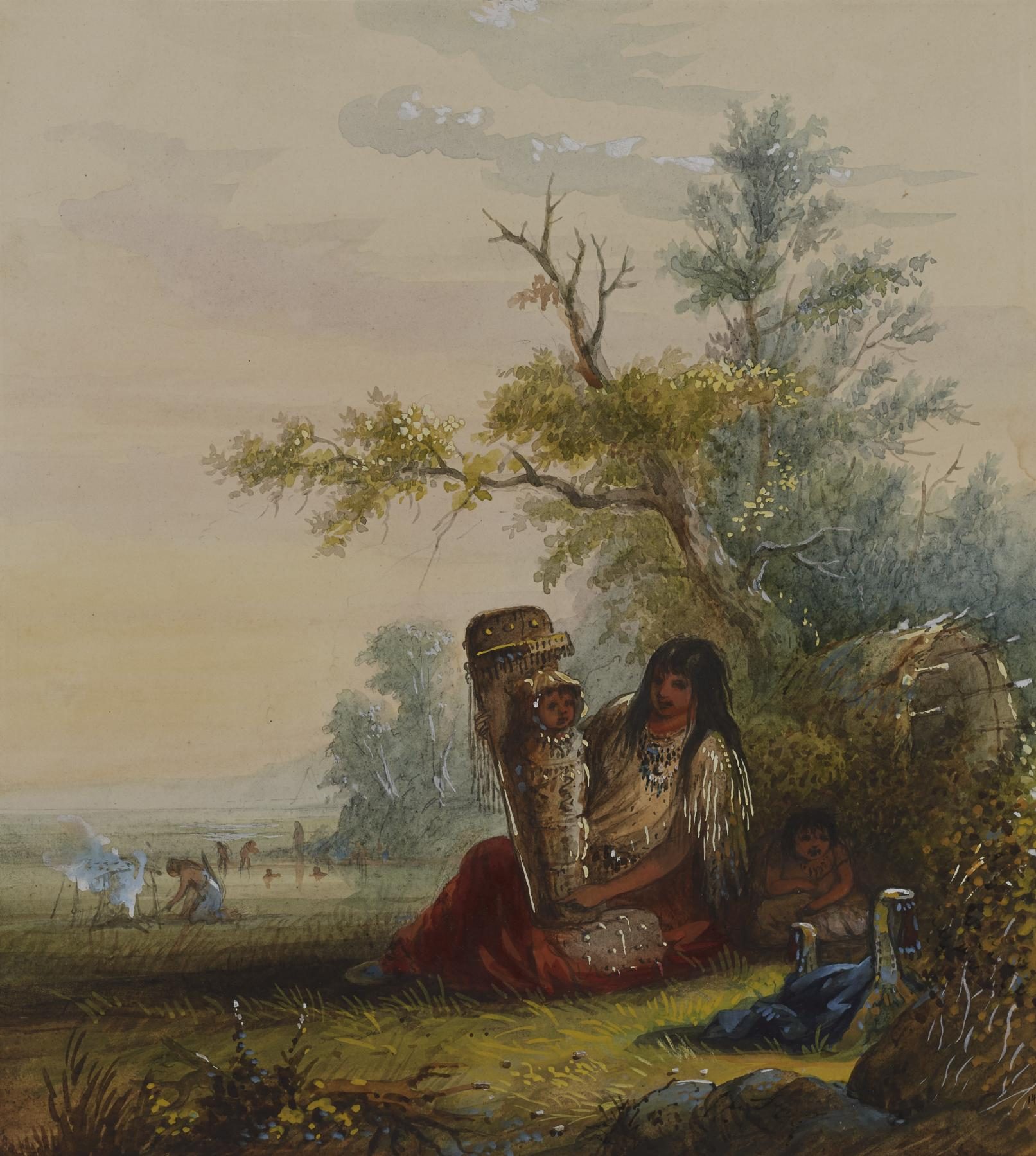
Walter Art Museum, Baltimore, MD
Courtesy: Walters Art Museum
Source:
(1) Jackson, Donald, Letters of the Lewis and Clark Expedition, Second Edition, Vol.1, University of Illinois, Urbana, page 236, note 5.
(2) Ibid, page 234-236.
(3) Ross, Marvin C., The West of Alfred Jacob Miller (1837): from the Notes and Water Colors in The Walters Art Gallery with an account of the artist, University of Oklahoma Press, Norman, 1951.