
Stop 2 of 5
Governing in a Multi-Faceted Culture
French, Spanish and United States Governments in St. Louis 1763-1804
In 1808 cultural changes were sweeping the country and St. Louis and it's several cultures were part of the changing fabric of the young United States. The Spanish style of governing was still strong in the minds of the former French and Spanish citizens. General Wilkinson's self-serving influence and Aaron Burr's seditious followers had their own agenda. United States policy and the cultural differences with the American Indian Nations added a destabilizing factor, made even more difficult by the British efforts to influence the Tribal People. Lewis and Clark had inherited few effective agents to work for the new American government in the territory. Frederick Bates, Territorial Secretary, clearly had a personal philosophy for governing the territory and it certainly did not agree with President Jefferson or Governor Lewis. Bates. was more trouble than value to the territorial government. (1)(2)
During the expedition Lewis and Clark were truly military commanders without bureaucrats second guessing every decision and expenditure. Now people 1000 miles to the East required written communications which slowed territorial governance. At the very best, it required a month of travel time to send documents or letters to Washington and an equal time to secure a response. The winter weather could require months to complete communication between Washington, D.C. and St. Louis. In addition to the travel time, security of the mail was doubtful. A detailed list of letters, related documents, and the travel time by several prominent people in St. Louis, including Lewis and Clark, are listed in Uncovering the Truth about Meriwether Lewis, by Thomas Danisi, Chapter 9 - "Was Governor Lewis' Correspondence Intentionally Delayed".
Public dissemination of laws and policy was by word of mouth or announcements posted as a broadside on a public bulletin board until Joseph Charless established the Missouri Gazette in 1808. The Gazette and printing business received financial support from both Lewis and Clark. (3) Even with the challenges, a great deal was accomplished between Clark’s return in April 1807 - Lewis' return on 8 March 1808 and their departure for Washington in September 1809. The partial list Includes:
- Improved strength of Fort Bellevue, later Ft. Madison, near Iowa - Missouri border. (1)
- Packaged and shipped the 1807 Big Bone Lick bones to Thomas Jefferson. (2)
- Assisted in establishing the Missouri Gazette by editor Joseph Charless. (3)
- Clark crossed Missouri again, guided by Nathan Boone, son of Danie Boone, to build Ft. Osage, east of present-day Kansas City. (4)
- Negotiated a Treaty with the Osage Indians. (5)
- Lewis wrote and published the Territorial Laws. (6)
- Completed work on the Observations and Reflections relating to the Indians and Fur Trade for Secretary Dearborn. (7)
- Organized the St. Louis Missouri Fur Company. (8)
- The eventual successfully return of Sheheke and his family to their home on the upper Missouri River with the contractual aid of the newly formed St. Louis Missouri Fur Company. (9)
- Appointed Daniel Boone to serve as a Justice of the Peace for the Femme Osage District and supported the building of a shot tower at Herculaneum, MO. (10)
- Authorize the building of roads or their improvement. (11)
- Directed Agent Boilvin to arrest four Indians involved in a murder of settlers. (12)
- Official Social Duties, personal finance affairs and helped organize Masonic Lodge #111. (13)
- Clark was absent from St. Louis for 12 months in 1807-08 for the historically significant dig and report from Big Bone Lick, KY for President Jefferson and his marriage and honey moon. Clark's return trip to St. Louis included transporting blacksmith tools and a grain mill for American Indian benefit. (14)
The above list is a very considerable body of work in only 28 months for two young government appointed administrators. Their experience in making decisions without the "shadow" of bureaucrats in Washington during the during the expedition is clearly reflected in their success is governing in the Upper Louisiana Territory while individuals like Secretary Bates and John Smith T worked to “undermine” Governor Lewis. Land Board decisions and John Smith T’s efforts to separate the lead mine region from the territory made governance extremely problematic. (15)
Unfortunately, Lewis had not written a single word for the editor of the Expedition Journals. The pressure had built to a crescendo when Bills of Exchange written by both Lewis and Clark are questioned and rejected by the new Madison Administration. The only solution was a trip to Washington to defend their action.
Shot Tower Herculaneum Missouri
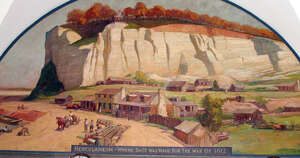
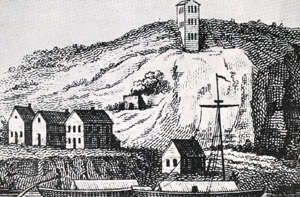
Herculaneum-Where Shot Making was and Industry, Oscar E. Berninghaus, 1920
Courtesy: Missouri State Capitol and City of Herculaneum
Meriwether Lewis Masonic Apron
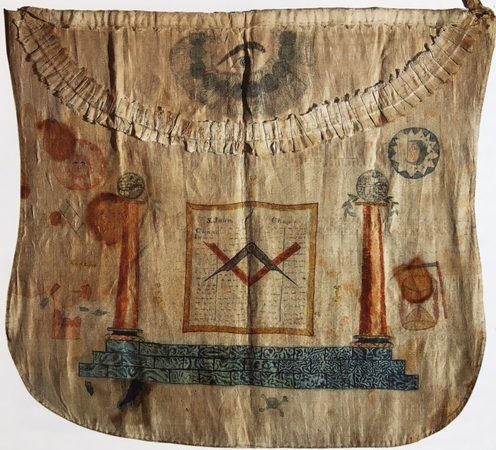
Courtesy: Grand Lodge of Montana, Helena, MT
Source:
(1) Jones, Landon, William Clark and the Shaping of the West, Hill & Wang, NY, 2004, page 173-174.
(2) Ibid, page 163.
(3) Holmberg, James, Dear Brother: Letters from William Clark to Jonathan Clark, Yale University Press, New Haven, 2002, page 136-note 15.
(4) Greg, Kate, (Editor), Westward With Dragoons: The Journal of William Clark, The Ovid Bell Press, Fulton, MO, 1937, page 15 -16.
(5) Ambrose, Stephen, Undaunted Courage: Meriwether Lewis, Thomas Jefferson, and the Opening of the West, Simon & Schuster, NY, 1996, page 447.
(6) Danisi, Thomas & Jackson, John, Meriwether Lewis, Prometheus Books, NY, 2009, page 12.
(7) Ambrose, Stephen, Undaunted Courage: Meriwether Lewis, Thomas Jefferson, and the Opening of the West, Simon & Schuster, NY, 1996, page 431.
(8) Ibid, page 444.
(9) Jones, Landon, William Clark and the Shaping of the West, Hill and Wang, NY, 2004, page 172.
(10) Ambrose, Stephen, Undaunted Courage: Meriwether Lewis, Thomas Jefferson, and the Opening of the West, Simon & Schuster, NY, 1996, page 446.
(11) Ibid, page 447.
(12) Ibid, page 441
(13) Ibid, page 443.
(14) Jones, Landon, William Clark and the Shaping of the West, Hill & Wang, NY, 2004, page 160 & 161.
(15) Turnbow, Tony, Jefferson’s Spy: The Secret Life of Meriwether Lewis, Vol 1, 2026, page 107-108